Why is everything round in space
Space & Astronomy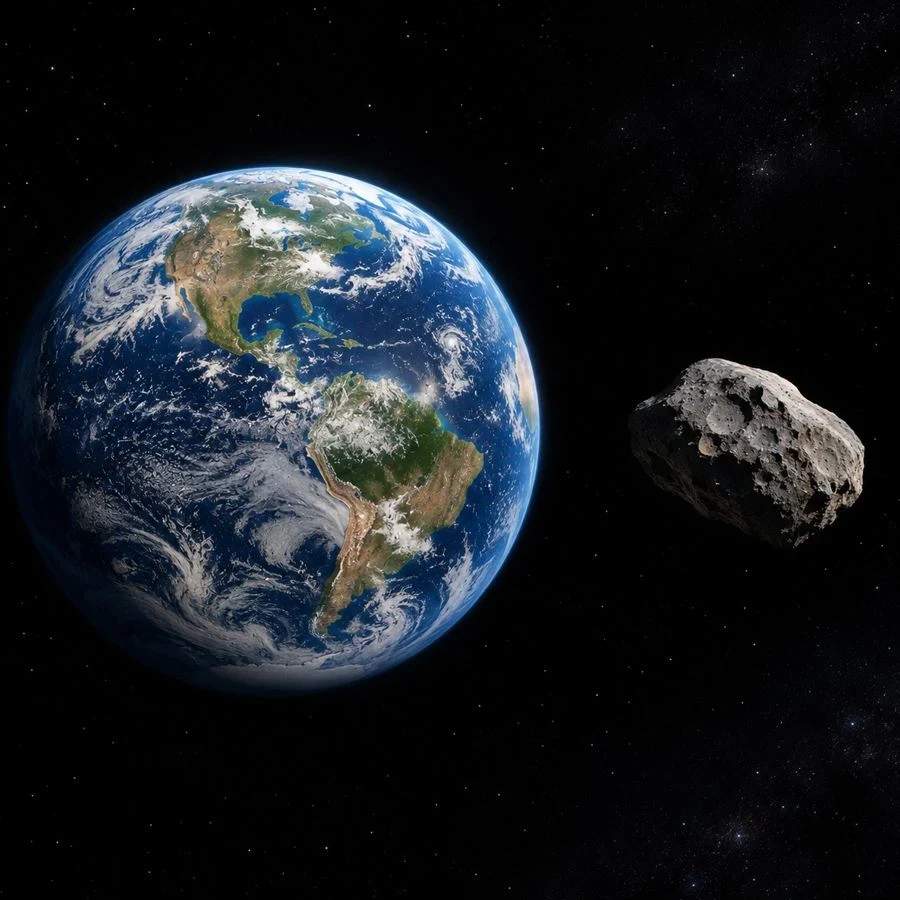
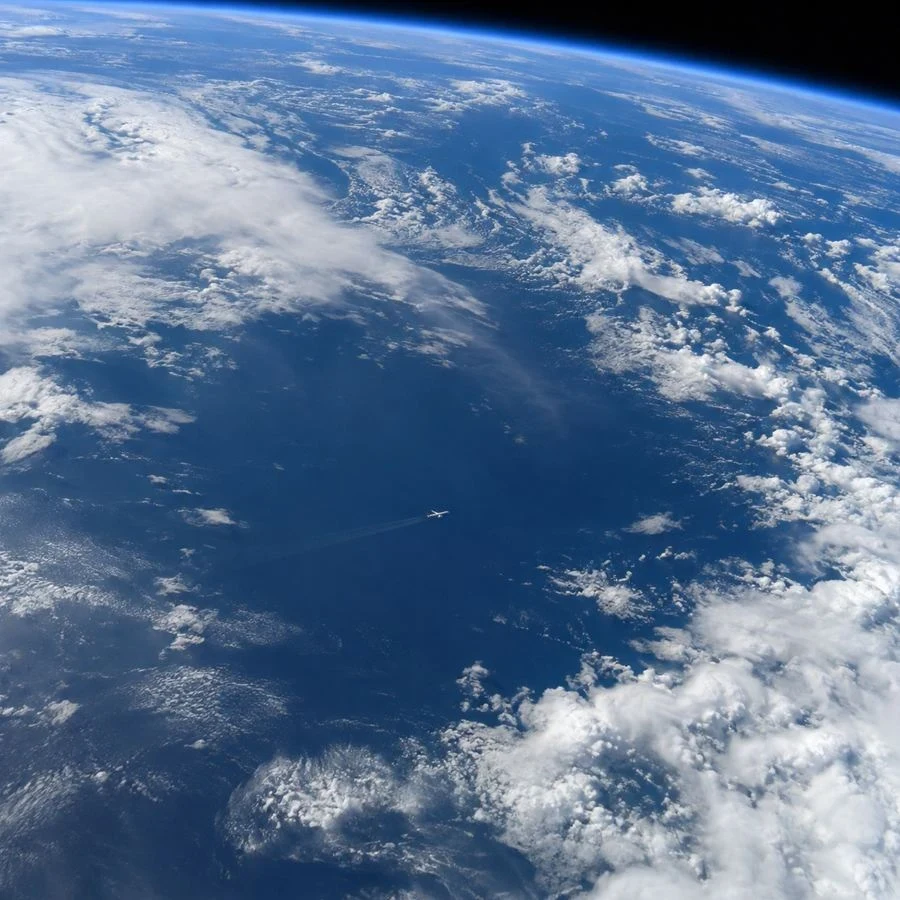
Look at photographs of Earth, Mars, or Jupiter, and you'll notice that these planets resemble enormous spheres floating in space. But take a closer look at smaller asteroids and comets, and the picture changes completely. Some resemble potatoes, while others have elongated or strangely connected shapes. So why is everything round in space, at least when it comes to large celestial objects? And if gravity makes planets spherical, why do structures like the Kuiper Belt form flattened disks? Let's explore how gravity shapes matter, why planets aren't perfectly round, and what determines the structure of our Solar System.
How does gravity shape matter
Gravity is the main reason large objects in space become nearly spherical. Every piece of matter attracts other matter, and as an astronomical object grows, its gravitational influence becomes stronger. During planetary formation, countless particles of dust, rock, and ice gradually accumulate into larger bodies. As more material gathers, the object's gravity begins to dominate its overall structure, pulling matter inward and helping create a rounded shape.
Imagine a young planet made of hot, partially molten material. Its surface might initially contain enormous irregularities, but tall protrusions experience gravitational forces that gradually deform them. Material redistributes until the interior pressure can balance the inward pull of gravity. For an isolated, nonrotating body made of fluid, the natural equilibrium shape is a sphere. Unlike a cube or pyramid, a sphere doesn't require large unsupported corners or projections to maintain its overall geometry.
This condition is called hydrostatic equilibrium. It describes a state in which the pressure inside an object balances the forces acting on its material. The principle applies to stars and gas giants as well as rocky worlds, although solid planets can preserve mountains, impact craters, and other surface features. Gravity doesn't literally polish every object into a smooth marble. Instead, it determines the large-scale shape when the body's mass is sufficient to overcome the strength of its materials.
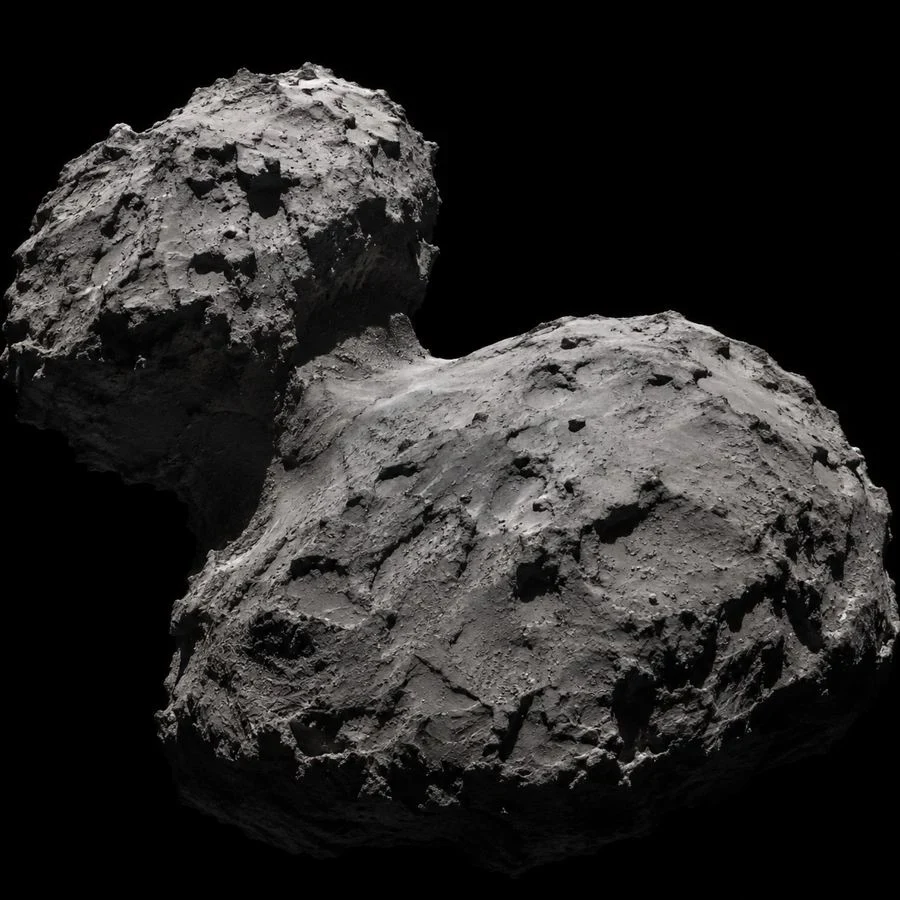
Small objects behave differently. An asteroid only a few kilometers across may have too little gravity to deform solid rock significantly. Its structural strength can preserve sharp edges, deep cavities, and elongated sections for millions or billions of years. A good example is comet 67P/Churyumov–Gerasimenko, studied by the Rosetta mission. Its two connected lobes form an unusual shape that could never be mistaken for a conventional planet.
There isn't one universal size at which every celestial object becomes spherical. Composition, temperature, internal structure, and material strength all matter. Ice can deform differently from rock, meaning an icy object may become rounded at a smaller size than a rocky object under suitable conditions. Large moons such as Earth's Moon and Jupiter's Ganymede are nearly spherical, while smaller moons like Phobos retain irregular shapes.
Being round also doesn't automatically make an object a planet. Ceres, for example, has enough mass to be nearly spherical but is classified as a dwarf planet. Under the Solar System's official classification, planetary status also depends on orbital characteristics, including whether an object has cleared its orbital neighborhood. Shape is therefore an important scientific clue, but it doesn't tell the entire story.
Are planets perfectly round
Most planets look like perfect spheres in ordinary space photographs, but precise measurements reveal that their shapes aren't quite so simple. One important reason is rotation. As a planet spins around its axis, different parts of its surface move in circles, and the resulting rotational effects influence how matter is distributed.
In a rotating reference frame, the centrifugal effect acts away from the rotation axis. This slightly reduces the effective inward pull near the equator, allowing a rotating planet to become wider around its middle and flatter near its poles. Scientists call this shape an oblate spheroid. The faster an object rotates, the more pronounced this effect can become, although its internal structure and gravitational strength also influence the result.
Earth provides a familiar example. Its equatorial radius is approximately 6,378 kilometers, while its polar radius is around 6,357 kilometers. That difference of roughly 21 kilometers is tiny compared with the planet's total size, so Earth appears almost perfectly round from a distance. Nevertheless, the difference matters for satellite navigation, geographic measurements, and scientific models of the planet.
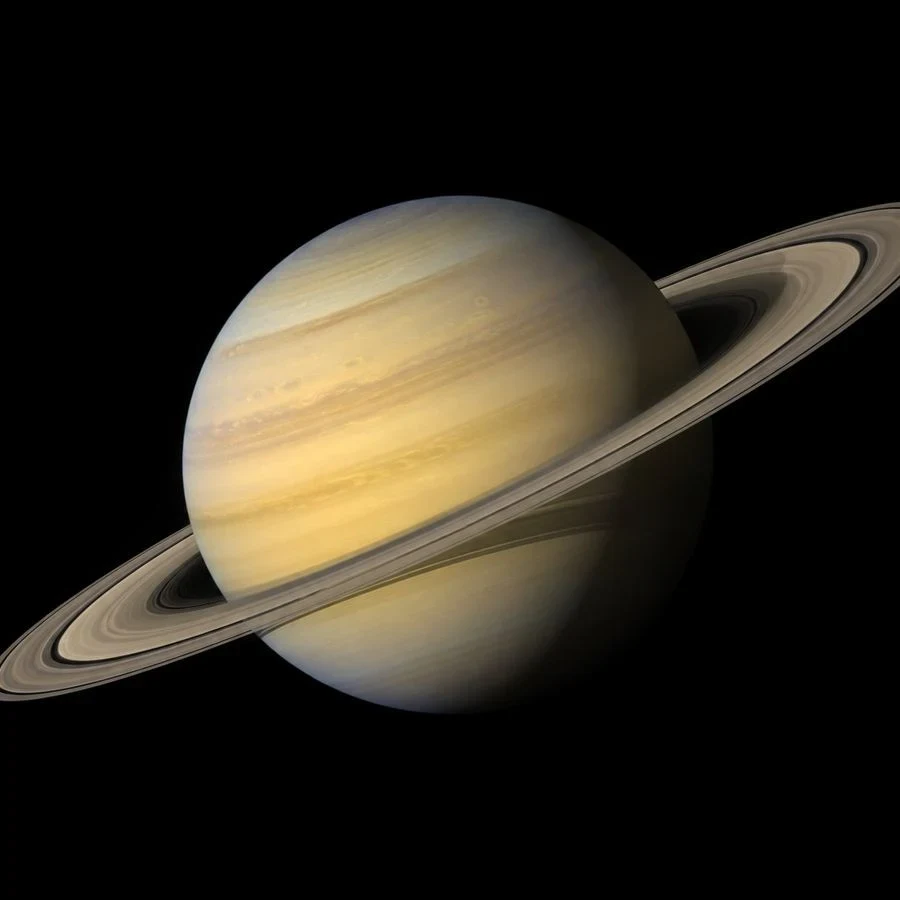
The effect becomes more obvious on Jupiter and Saturn. These enormous gas giants rotate rapidly, creating noticeable equatorial bulges. Saturn is especially flattened, with its equatorial diameter exceeding its polar diameter by approximately 10.7%. Jupiter also has a pronounced bulge, although not quite as large. By comparison, slowly rotating Mercury and Venus are much closer to spherical shapes.
Rotation isn't the only factor. Rocky planets have mountains, valleys, and impact basins, while differences in internal density produce variations in their gravitational fields. Earth scientists use the geoid, an idealized surface of equal gravitational potential that closely follows mean sea level, to describe some of these variations. This provides a more realistic representation than treating our planet as a mathematically perfect sphere.
Even stars can become noticeably flattened. Rapidly rotating stars may have wider equatorial regions, demonstrating that the same physical principles apply to many kinds of massive celestial bodies. In some extreme systems, gravitational interactions with a nearby star can also distort a planet's shape through tidal forces.
The important distinction is that planets are approximately spherical, not geometrically flawless balls. Their gravity creates the overall rounded form, while rotation, internal structure, and external forces introduce measurable differences. That's why the familiar spherical planets shown in space strategy games are useful representations, even though reality is a little more complicated.
Then why is the Kuiper Belt flat
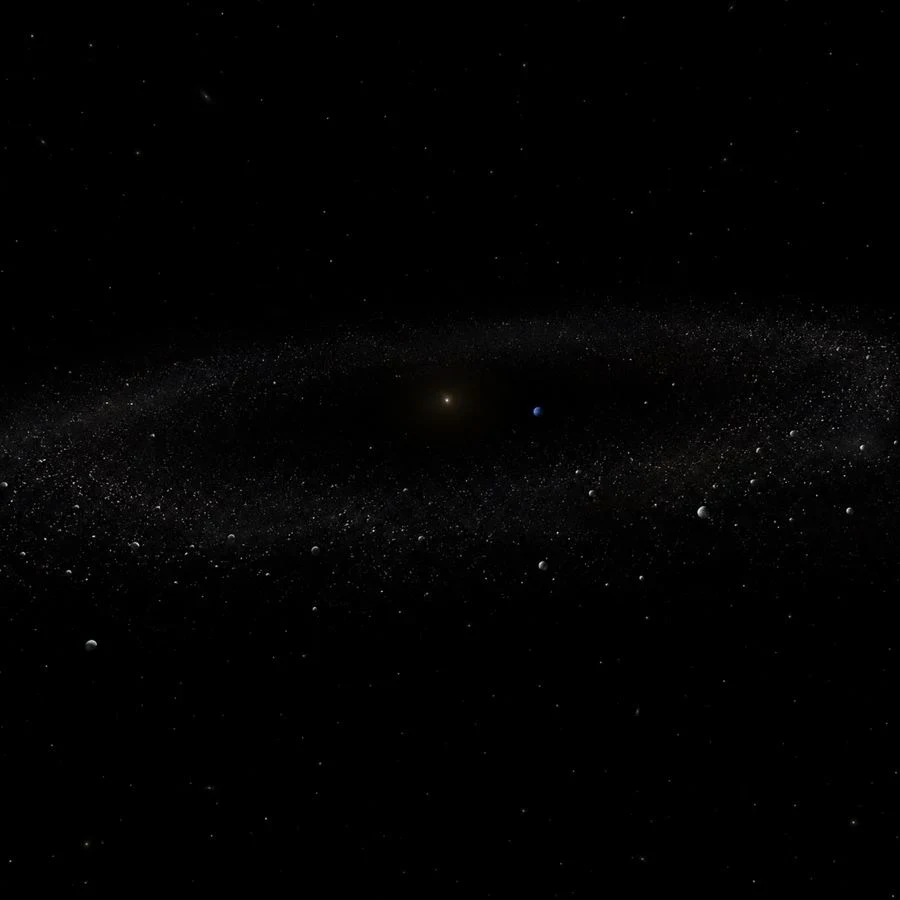
If gravity tends to make massive objects round, why does the Kuiper Belt resemble a flattened disk? The answer is that the belt isn't one enormous solid object. It's a vast region containing many separate icy and rocky bodies orbiting the Sun beyond Neptune. Each follows its own trajectory, and their combined distribution creates a thick, disk-like structure rather than a giant sphere.
The main Kuiper Belt extends roughly from 30 to 50 astronomical units from the Sun. One astronomical unit represents approximately the average distance between Earth and the Sun, so these objects occupy an extremely distant region of our planetary system. Although illustrations sometimes show a dense ring of material, the actual objects are separated by enormous distances.
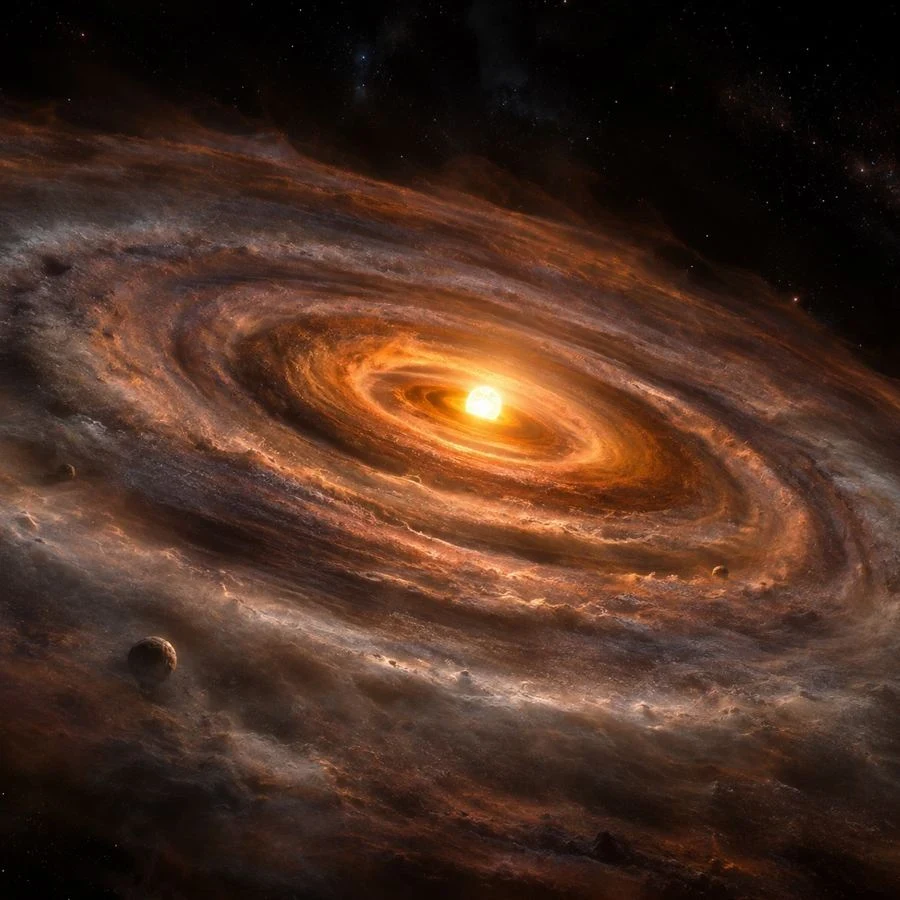
To understand its shape, we need to return to the formation of the Solar System around 4.6 billion years ago. The Sun and planets developed from a large cloud of gas and dust that contracted under gravity. As the cloud collapsed, conservation of angular momentum influenced its rotation, while collisions and interactions between particles helped concentrate material into a flattened protoplanetary disk.
Within this disk, small particles gradually combined into larger bodies, eventually producing planets, moons, asteroids, and other objects. Not all the original material became part of a major planet. The Kuiper Belt preserves some of the icy remnants of this early formation process, making it an important region for studying the Solar System's history.
However, the Kuiper Belt isn't perfectly flat. Its overall shape resembles a thick donut, and individual objects can have orbits inclined above or below the main planetary plane. Some follow relatively circular, low-inclination trajectories, while others travel along more elongated or tilted orbits. These differences reflect the gravitational history of the region.
Neptune has played a particularly important role in shaping the belt. Its gravitational influence helped redistribute distant objects, while orbital resonances created stable relationships between some of their orbital periods. Pluto provides a famous example: it completes approximately two orbits around the Sun for every three completed by Neptune.
Other objects belong to populations with substantially more inclined or elongated trajectories. Beyond the main belt, the scattered disk contains bodies that can travel much farther from the Sun. These populations show why the Kuiper Belt should be understood as a dynamic collection of objects rather than a perfectly uniform, flat ring.
The distinction between individual shapes and collective structures is essential. A large dwarf planet within the Kuiper Belt may be almost spherical because of its own gravity, while the entire population forms a disk because of its shared orbital history. Similarly, many galaxies contain flattened stellar disks even though their individual stars are approximately spherical.
Not every distant structure follows this pattern. The hypothetical Oort Cloud, thought to surround the Solar System far beyond the Kuiper Belt, is generally modeled as having a much more spherical distribution of icy objects. Its different structure reflects a different history of gravitational interactions.
So there's no contradiction between round planets and flattened regions of space. Gravity shapes individual massive bodies, while angular momentum, orbital motion, and collisions influence how collections of objects are arranged. The result is a universe filled with spheres, disks, rings, and countless irregular objects rather than one universal shape.
Explore distant worlds with WarForGalaxy
The universe contains an incredible variety of planets, moons, and mysterious objects waiting to be explored. If you enjoy discovering new worlds and building powerful civilizations, WarForGalaxy lets you turn that fascination into an interstellar adventure.
WarForGalaxy is a free cross-platform multiplayer 4X space strategy game where you can develop planetary colonies, research technologies, manage resources, and construct military fleets. Starting with a small settlement, you'll expand your territory and transform your civilization into a growing galactic empire.
You'll also encounter players from around the world, creating opportunities to build alliances, coordinate military operations, and participate in large-scale space wars. The game features Hermes, an AI assistant designed to support strategic analysis and selected routine management tasks, helping you focus on important decisions.
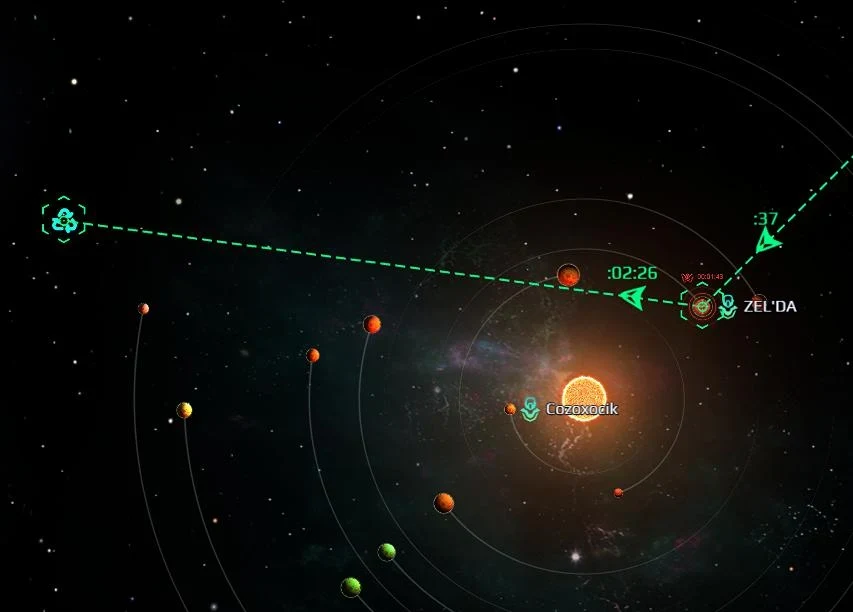
WarForGalaxy is accessible on computers and smartphones, and the PC version runs directly in your browser without a separate client installation. Whether you prefer economic expansion, diplomacy, or military conquest, your strategy determines how your empire develops.
Ready to establish your place among the stars? Play WarForGalaxy for free, explore distant planets, build powerful fleets, and lead your civilization toward galactic domination.